 Arlington Restoration Group
Mold Remediation for Arlington Businesses and Buildings
Commercial properties bring their own version of the same underlying problem — moisture that wasn't fully addressed, left long enough for mold to develop. Office buildings, retail space, restaurants, medical offices, and multi-unit buildings across Arlington's commercial corridors all see it, and the fundamentals of remediation are the same as in a home: find the source, contain the area, remove what can't be cleaned, and confirm the work is finished.
Common Commercial Sources
- Rooftop HVAC units and ductwork condensation
- Plumbing chases and shared risers in multi-tenant and high-rise buildings, especially through the Rosslyn-Ballston and National Landing corridors
- Roof leaks around flashing, parapets, and rooftop equipment
- Below-grade parking garages, loading docks, and storage areas
- Kitchen equipment leaks in restaurant and food service spaces
- A slow leak inside a wall or ceiling that goes unnoticed longer in a space that isn't occupied every day
Why Commercial Jobs Are Different From Residential
A commercial mold job usually involves more stakeholders than a residential one — a property manager, sometimes a building engineer, one or more tenants, and occasionally a landlord separate from the tenant who reported the problem. Access can also be more complicated: work may need to happen after hours or on a weekend to avoid disrupting a retail storefront or an office during business hours, and some spaces — server rooms, commercial kitchens, medical suites — carry equipment or compliance considerations that affect how work is sequenced.
Minimizing Disruption to Tenants and Operations
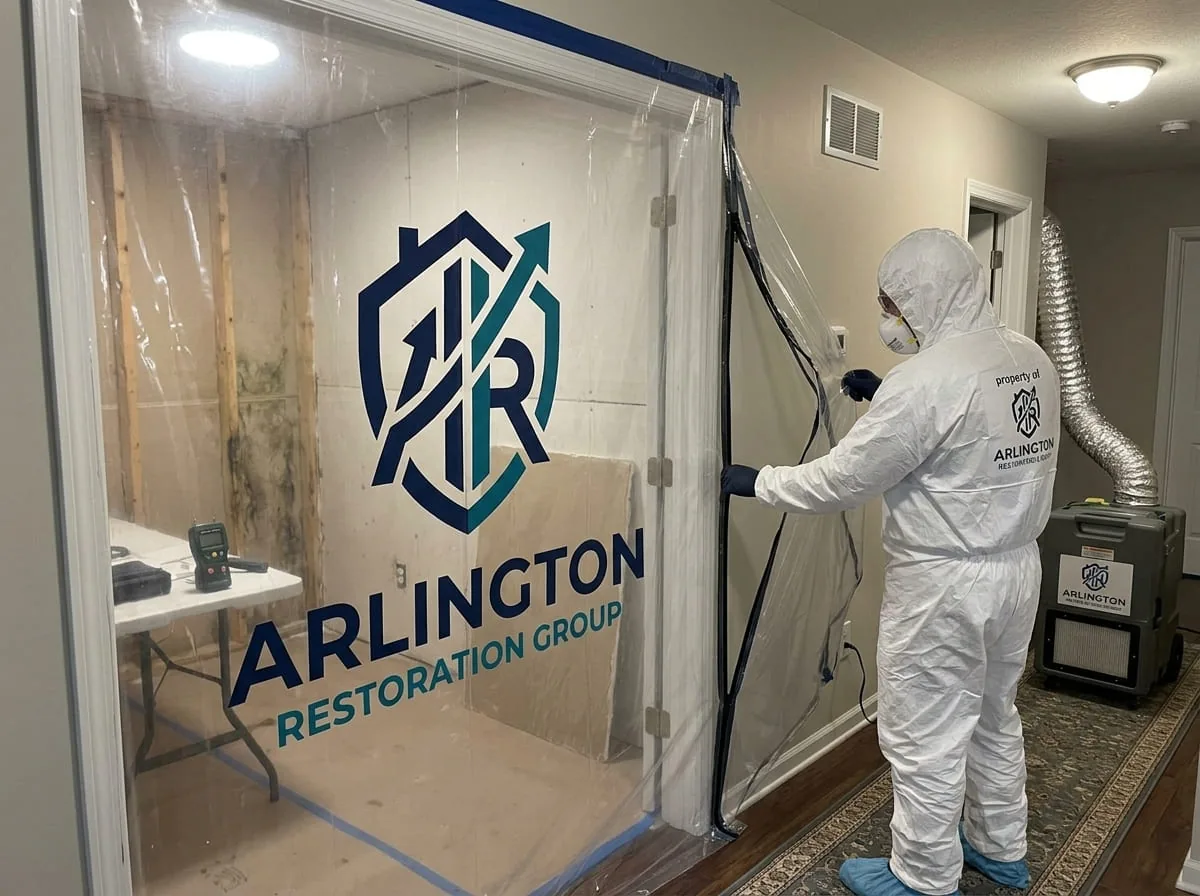
Where the scope allows, containment can isolate the affected area while the rest of a building or suite stays in normal use, rather than requiring a full shutdown. That's not possible in every situation — a large or centrally located area of growth, or one connected to shared HVAC, may require broader access — but it's assessed case by case rather than defaulting to the most disruptive option available.
What the Process Involves
The same core steps apply as any remediation job: containment, removal of materials that can't be effectively cleaned, cleaning and treatment of salvageable surfaces, and drying. Negative air machines and HEPA filtration tend to be used more routinely on commercial jobs, given the larger air volumes involved and, often, the need to keep adjacent occupied space unaffected while work is underway. Larger commercial floor plans can also mean staged work — containing and clearing one section while a following section is assessed — rather than treating the entire footprint as a single job that has to finish all at once.
Scheduling Around Occupancy
Retail storefronts, restaurants, and customer-facing offices generally can't pause operations for an extended period, so work is often planned around business hours, delivery schedules, and peak customer traffic where the scope allows. A back-of-house area or storage room may be workable during the day with basic containment, while anything visible from a sales floor or lobby is more likely to be scheduled overnight or on a closed day. None of this changes the underlying remediation steps — it changes when and how they're sequenced around the business.
Documentation for Property Management, Insurance, and Tenants
Commercial mold jobs often come with a documentation need residential ones don't — a report for a property management company, support for a tenant improvement dispute, or documentation an insurance carrier requests before approving a claim. That documentation can include inspection findings, photos, and, where sampling was performed, lab results. See mold testing and sampling and post-remediation verification and clearance for what's involved.
Working With Property Management and Building Engineering
In multi-tenant office and retail buildings, property management or an on-site engineering team is often the first point of contact, and they typically coordinate access, review findings, and decide how the work fits around other building operations. Bringing them into the loop early — rather than after an assessment is already scheduled — tends to make scheduling and access smoother, particularly in buildings with security desks, freight elevator reservations, or after-hours access procedures.
Multi-Tenant Buildings and Shared Responsibility
A leak or mold problem in a multi-tenant building doesn't always originate in the space where it's discovered — a shared riser, a roof, or a neighboring unit can be the actual source, which raises questions about who's responsible for what. Sorting out responsibility between a landlord, a tenant, and possibly a neighboring tenant is a property management and, sometimes, legal question rather than something a remediation assessment settles on its own. The physical work — assessing, containing, and remediating the affected space — can generally proceed while that gets sorted out.
Before Help Arrives & What to Avoid
If you manage or occupy a commercial space and suspect mold, avoid running shared HVAC systems that pass through the affected area until it's been assessed, since ductwork can move air, and potentially spores, to other parts of the building. Restrict access to the area rather than continuing normal foot traffic through it, and document what you're seeing with photos and notes on when it was first noticed. If the space is leased, notify your landlord or property manager promptly — delays can complicate both the remediation timeline and any related claim.
Related Services
See residential mold remediation for how the approach differs in a home, mold inspection to scope a suspected problem, mold testing and sampling for lab-confirmed documentation, and the mold remediation overview for the full range of services. If the mold followed a specific commercial water loss, see commercial water damage restoration. Commercial mold remediation is available across Arlington's business corridors, including Ballston & Virginia Square and Crystal City & Pentagon City.
Frequently Asked Questions
Can a commercial space stay open during mold remediation?
Often, yes, for a contained area — but it depends on the location, size, and connection to shared systems like HVAC. It's assessed case by case rather than assumed one way or the other.
Who typically handles insurance documentation for a commercial mold claim?
Insurance claim assistance is available through the restoration professionals handling the work, though how a claim is split between landlord and tenant coverage depends on the lease and each party's policy.
Does a shared HVAC system need to be inspected too?
If ductwork passes through or near the affected area, it's worth having it assessed, since air movement can carry spores to other parts of the building beyond the original problem area.
How does a mold finding affect a commercial lease or tenant dispute?
That depends on the specific lease terms and circumstances, and it's a question for property management or legal counsel rather than something a remediation assessment can answer on its own. The physical remediation can proceed while that's sorted out.
Is commercial mold remediation available outside business hours?
24/7 emergency response is available, and non-emergency commercial work can often be scheduled after hours or on weekends to limit disruption to tenants and customers.